
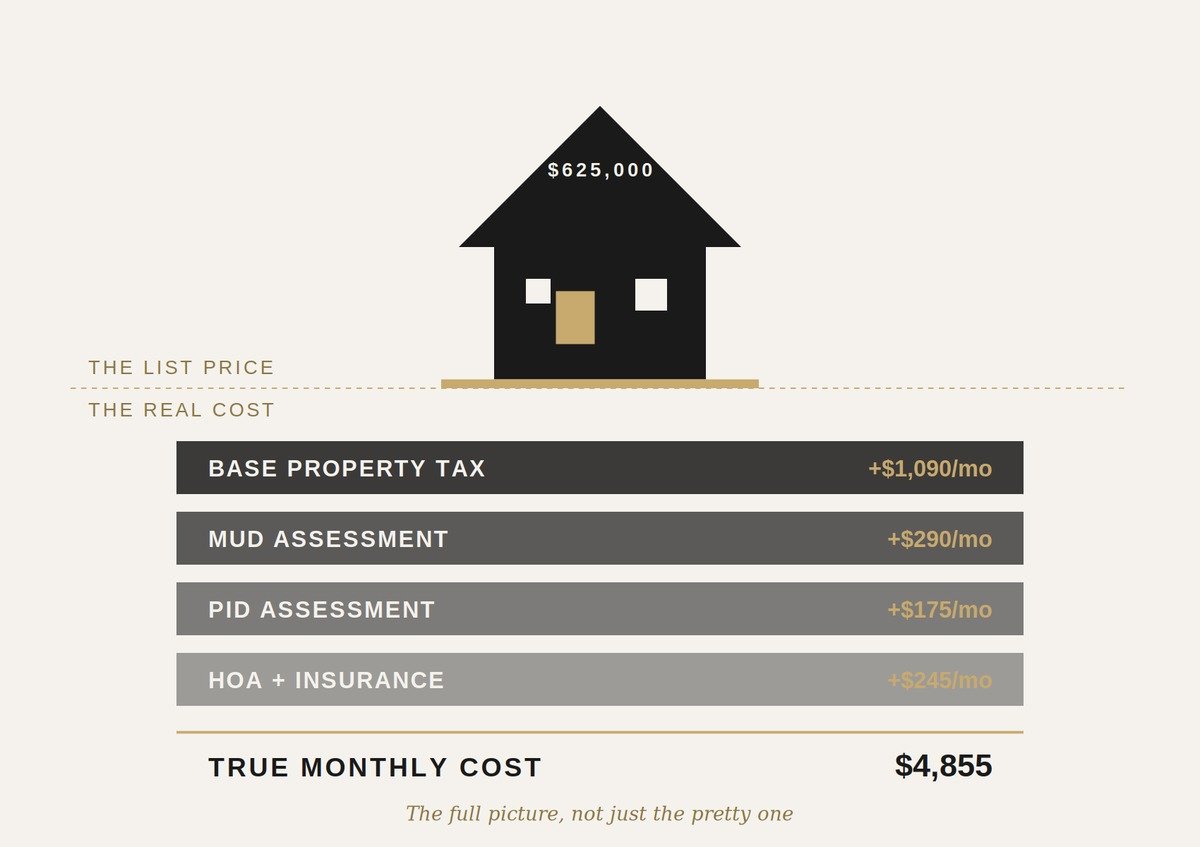
HousesByNeda — The full picture on MUD PID tax in North Dallas, not just the pretty one.
If you are relocating to North Dallas, understanding the MUD PID tax in North Dallas communities is critical before you buy. In fact, here’s a conversation I have almost every single week with buyers relocating to Frisco, Prosper, and Celina:
“Neda, our lender said we qualify for a $650,000 home. We found the perfect new construction in Celina at $625,000. Why is the monthly payment estimate $400 higher than the one we ran on Zillow?”
The answer is almost always the same three letters: MUD. Or PID. Sometimes both. Therefore, if you’re buying new construction anywhere north of Frisco, you need to understand these special tax districts before you sign a contract — not after.
Understanding MUD PID Tax in North Dallas: What Is a MUD?
Essentially, a MUD (Municipal Utility District) is a special taxing district created to fund the water, sewer, drainage, and road infrastructure in a community developed outside normal city utility limits. As a result, the developer issues bonds to build all that infrastructure up front — and homeowners repay those bonds through an annual property tax levy, on top of your regular city and county taxes.
Typically, MUD tax rates range from $0.30 to $1.00 per $100 of assessed value. For example, on a $500,000 home, that can add $1,500 to $5,000 to your annual tax bill — or roughly $125 to $417 per month to your escrow payment.
However, there is good news: MUD rates usually decline over 10 to 20 years as the bonds get paid down and more homes come online to share the burden.
What Is a PID (Public Improvement District)?
In contrast, a PID is a different animal. It’s a special assessment (not a tax, technically) that funds neighborhood-specific enhancements — entry monuments, enhanced landscaping, community pools, private trails, pocket parks, and walking paths. In other words, think of it as paying for the lifestyle upgrades that make those Instagram-worthy master-planned communities look so good.
Generally, PIDs run 20 to 40 years with a fixed assessment amount. Moreover, there is a unique feature: you can usually pay off your portion in a single lump sum and eliminate it. Nevertheless, most buyers don’t take advantage of this option because the payoff can be $15,000 to $40,000 depending on the community.
The Real Math — How MUD PID Tax in North Dallas Blindsides Buyers
Here’s where it gets painful. Your regular property tax in Frisco is around 2.0 to 2.18 percent. Meanwhile, Prosper sits just above 2 percent, and Celina base rates fall in that same range. Consequently, those are the numbers most buyers see on Zillow or Realtor.com.
However, once you layer in MUD or PID assessments, your true effective tax rate can climb to 2.8 to 3.2 percent. On a $600,000 home, that’s the difference between $12,000 a year in taxes and $18,000 a year. As a result, that adds six thousand dollars to your bill every single year.
| Scenario | Monthly Payment | Annual Difference |
|---|---|---|
| Base tax only (2.1%) | $4,280 | Baseline |
| With MUD ($0.80/$100) | $4,680 | +$4,800/year |
| With MUD + PID | $4,855 | +$6,900/year |
In summary, same house, same list price, and same interest rate — but three very different monthly payments and three very different answers to the question of what you can actually afford.
Which North Dallas Communities Have MUD or PID?
Although this is not an exhaustive list, and communities change over time, here’s the general landscape of MUD PID tax in North Dallas:
- Light Farms (Celina) — PID for infrastructure and amenities. Be sure to research the PID schedule before you offer.
- Mustang Lakes (Celina) — PID for community infrastructure.
- Windsong Ranch (Prosper) — PID assessment in place.
- Edgestone at Legacy (Frisco) — MUD district where rates decline over time.
- The Grove (Frisco) — Several sections have MUD or PID depending on phase.
- Phillips Creek Ranch (Frisco) — PID assessment.
- Union Park (Little Elm/Prosper ISD) — Check by section because some phases have MUD.
On the other hand, most established resale homes in the core of Frisco and Plano do not have MUD or PID — because those cities had the tax base to fund infrastructure the traditional way. For this reason, resale homes in older Frisco neighborhoods sometimes look more expensive on paper but end up with lower true monthly costs.
The Four Questions to Ask Before You Offer
- Is there a MUD or PID on this specific lot? — Always ask the builder in writing, and don’t trust the marketing flyer.
- What is the total annual assessment? — This is a legally required disclosure in Texas, so make sure you receive it before signing.
- What’s the current rate and the rate schedule? — For instance, a 2-year-old MUD at 0.95 is very different from a 15-year-old MUD at 0.35.
- Can I pay it off in a lump sum? — For PIDs only — in some cases, paying off the assessment at closing beats carrying it for 30 years.
Why MUD PID Tax in North Dallas Matters for Your 2% Rebate
Here’s something most buyers don’t realize: a 2 percent buyer rebate at closing on a $625,000 Celina new build is $12,500. Specifically, that’s approximately two and a half years of MUD payments on an average district, covered by the rebate alone.
When I sit down with a buyer, I don’t just show you the list price. Instead, I show you the true all-in monthly cost — base tax, MUD, PID, HOA, insurance, principal, and interest — and then I put the rebate against it so you can see what you’re actually paying to live there. Ultimately, that’s not a sales tactic — that’s just math done honestly.
Ready to See Your True All-In Cost?
Visit northtexasbuyerrebate.com and I’ll run the numbers with you — MUD, PID, HOA, and all. No pressure. Just the full picture.
Neda Dameshghi | HousesByNeda | North Texas Realtor | Buyer Specialist | Seller Specialist | Serving Frisco, Prosper, Celina, and Plano | 469-960-5580