
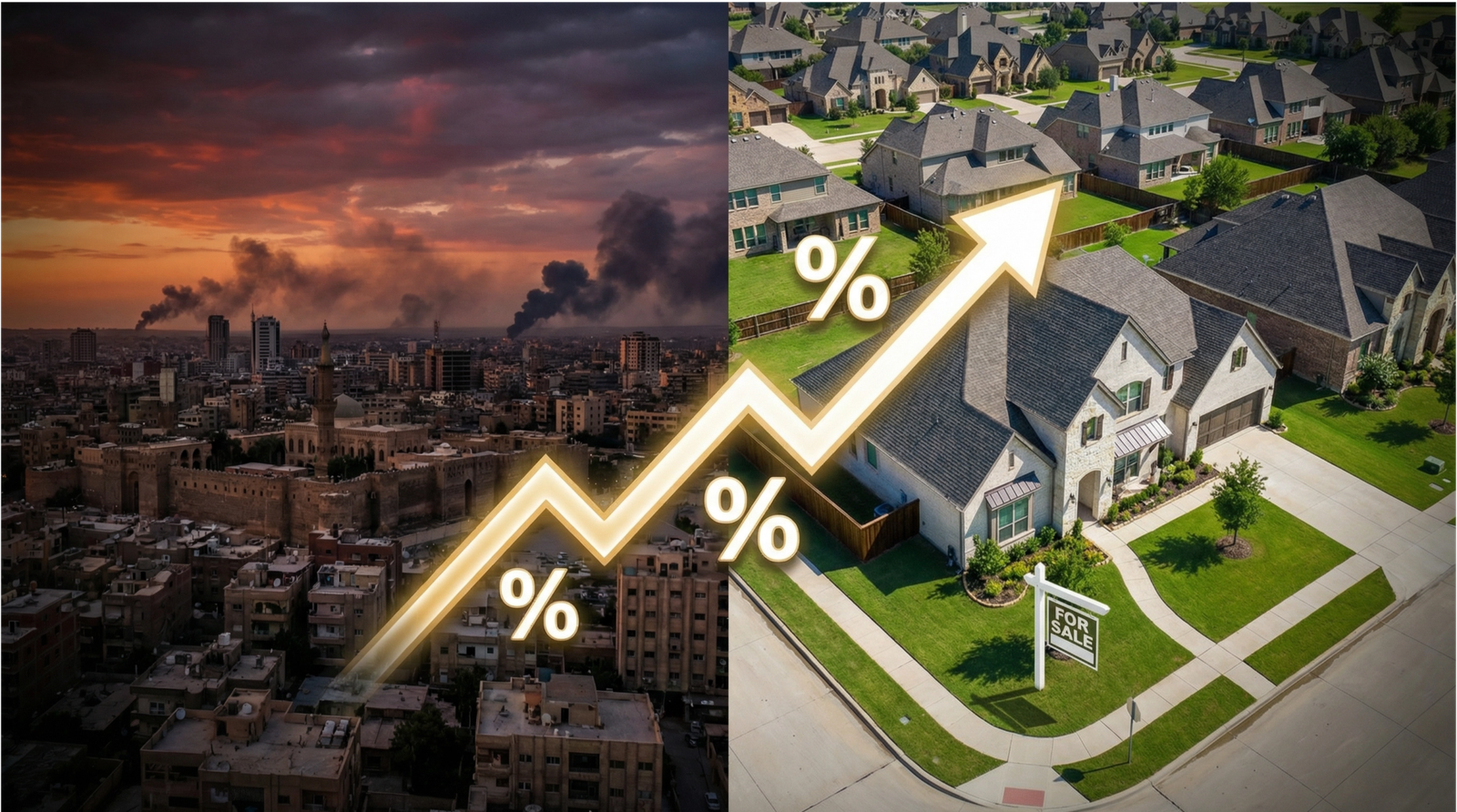
For home buyers and sellers in North Dallas, the start of the 2026 spring market has been anything but predictable. Just as a welcome dip in Iran conflict mortgage rates below 6% began to energize the housing market, the outbreak of the U.S.–Iran conflict introduced a new wave of uncertainty. As a North Dallas realtor serving communities from Frisco to Plano, Prosper, and Celina, I know my clients are asking one key question: What does this conflict mean for my real estate plans?
This post breaks down the complex relationship between geopolitical events, the economy, and our local housing market — using the latest data and expert analysis to provide clarity in a volatile time.
Iran Conflict Mortgage Rates: Why They Jumped
In the last week of February 2026, the average 30-year fixed mortgage rate fell to 5.98% — the first time it had dropped below 6% since 2022, according to Freddie Mac [1]. This was a significant, positive development that had buyers across North Dallas feeling optimistic heading into the spring season.
But within days of the U.S.–Israeli strikes on Iran, that trend reversed sharply. By March 4, the average rate had climbed back to 6.15%, according to Bankrate’s latest lender survey [2].
Why the sudden jump? The answer lies in the bond market and its reaction to the conflict. Here is the chain of events, explained simply:
First, the conflict created economic uncertainty — particularly around energy. Although Iran produces only about 3% of the world’s oil, approximately 20% of global crude oil shipments pass through the Strait of Hormuz, a narrow waterway near Iran [3]. The threat of disruption to that chokepoint sent Brent crude oil prices surging more than 8% on Monday, approaching $79 per barrel [3].
Higher oil prices are a powerful driver of inflation because energy costs work their way into the price of nearly every physical good in the economy. When investors in the bond market see oil prices spike, they demand higher yields on long-term bonds to protect against the future inflation they expect. The yield on the 10-year U.S. Treasury note — the key benchmark that mortgage rates closely follow — jumped back above 4%, and mortgage rates rose with it [4].
“Fear of higher inflation because of higher oil prices tends to push rates up, but fear about global stability and economic growth tends to push rates down.” — Daryl Fairweather, Chief Economist, Redfin [4]
In this case, inflation fears won out over safe-haven bond buying, and the result was a quick reversal of the rate progress buyers had celebrated just days before.
Iran Conflict Mortgage Rates: Putting the Numbers in Perspective
While the headlines about rising rates can feel alarming, it is important to understand what the change actually means for your monthly payment. As Brad Case, Chief Economist at Homes.com, points out, the week-over-week impact is real but modest — especially compared to where rates stood at their 2023 peak [5].
| Scenario | Rate | Monthly P&I on a $400K Loan |
|---|---|---|
| October 2023 Peak | 7.80% | $2,877 |
| Late February 2026 (pre-conflict) | 5.98% | $2,393 |
| Early March 2026 (post-conflict) | 6.15% | $2,439 |
| Difference (Feb vs. Mar 2026) | +0.17% | +$46/month |
The recent rate increase adds approximately $46 per month to a typical mortgage payment on a $400,000 loan. That is a meaningful number, but it pales in comparison to the more than $480 per month in additional payment burden buyers faced at the 2023 rate peak. Today’s buyers still have significantly more purchasing power than they did just 18 months ago.
Two Paths Forward: What Experts Are Watching
Scenario 1: A Short, Contained Conflict
If the military campaign concludes relatively quickly without escalating into a prolonged regional war, the spike in oil prices and inflation expectations will likely be temporary. In this scenario, experts believe Iran conflict mortgage rates could settle back toward the 6% mark. Lisa Sturtevant, Chief Economist at Bright MLS, summarized it well: “The spring homebuying season might get a late start, but sales would likely rebound” [2].
Scenario 2: A Prolonged, Wider Conflict
If the conflict drags on for months and causes sustained disruptions to oil supplies through the Strait of Hormuz, the resulting inflation could force the Federal Reserve to delay its planned interest rate cuts. This would keep mortgage rates elevated, likely in the 6.0% to 6.5% range for the remainder of 2026, according to the Mortgage Bankers Association [6].
This scenario could create a more significant slowdown in home sales, as buyers and sellers alike adjust to a “higher for longer” rate environment.
The Federal Reserve is set to meet later this month, and financial markets now assess a 53% chance that the Fed will leave rates unchanged through its June meeting — up from just 43% before the strikes began [3]. That would mean three consecutive meetings with no rate relief, with any cuts potentially delayed until July at the earliest.
How Iran Conflict Mortgage Rates Affect the North Dallas Spring Market
The North Texas housing market entered 2026 in a position of gradual improvement. Inventory had been rising, price growth had moderated to just 1.3% nationally in 2025 [2], and the dip below 6% was beginning to unlock buyer demand that had been sitting on the sidelines for years.
The Iran conflict has temporarily paused that momentum, but it has not erased it. Redfin is still projecting 3% more home sales nationally in 2026 compared to 2025, along with 1% price growth [4]. For markets like Frisco, Prosper, and Plano — which continue to attract corporate relocations, strong job growth, and top-ranked school districts — the underlying demand fundamentals remain intact.
The most important variable for North Dallas buyers and sellers right now is not what is happening in Tehran. It is what happens in the U.S. labor market. February payroll data and the jobs report will be released this week, and strong employment numbers could actually push rates lower by reassuring the Fed that the economy can handle a rate cut [4].
My Advice for Buyers and Sellers in Frisco, Plano, Prosper & Celina
For Buyers
Do not let a $46-per-month rate fluctuation derail a decision you have been planning for months. If you are financially ready and have found the right home, the long-term case for homeownership in North Dallas remains as strong as ever.
The most important step you can take right now is to get pre-approved so you are positioned to move quickly when the right property comes along. A pre-approval also signals to sellers that you are a serious, low-risk buyer — a powerful advantage in any market condition.
For Sellers
Strategic pricing is more critical than ever. With buyer demand sensitive to rate fluctuations, a home that is priced even slightly above market value will sit. Work with your agent to price competitively from day one, and lean into the features that make your home stand out — energy efficiency, a dedicated home office, proximity to top-rated schools, and community amenities all carry significant weight with today’s buyers.
The Bottom Line on Iran Conflict Mortgage Rates
The conflict in Iran has introduced a new layer of complexity to the 2026 housing market, but it has not changed the fundamental story. Iran conflict mortgage rates are still dramatically lower than their 2023 peak, inventory is improving, and North Dallas remains one of the most desirable real estate markets in the country.
The path forward may be bumpier than we hoped a week ago, but the destination remains the same.
I am monitoring these developments daily and will continue to share updates here and on my social channels. If you have questions about buying or selling in Frisco, Plano, Prosper, Celina, or anywhere in North Dallas, I am here to help you navigate every step of the process.
Ready to take the next step? Visit www.housesbyneda.com or reach out directly. Follow me on Instagram and Facebook — @HousesByNeda — for daily market updates, and subscribe to my YouTube channel livingNorthDallas for in-depth video breakdowns of the North Texas market.
Neda Dameshghi is a top-rated North Dallas realtor and buyer/seller specialist serving Frisco, Plano, Prosper, Celina, and the surrounding communities. Connect with Neda on LinkedIn and TikTok.
References
[1] PBS NewsHour. “Average U.S. long-term mortgage rate dips below 6% for the first time since 2022.” pbs.org
[2] Bankrate. “Mortgage Rates Rise, But Still Near Three-Year Lows.” March 4, 2026. bankrate.com
[3] Realtor.com. “Iran Conflict Sends Oil Prices Up in Troubling Sign for Mortgage Rates.” March 2, 2026. realtor.com
[4] Marketplace. “How even mortgage rates are impacted by the war in the Middle East.” March 4, 2026. marketplace.org
[5] Homes.com. “Analysis: Why the attack on Iran nudged mortgage rates back up.” March 3, 2026. homes.com
[6] Morningstar/MarketWatch. “Should you buy or sell a home now? What the Iran conflict means for the spring home-buying season.” March 4, 2026. morningstar.com