

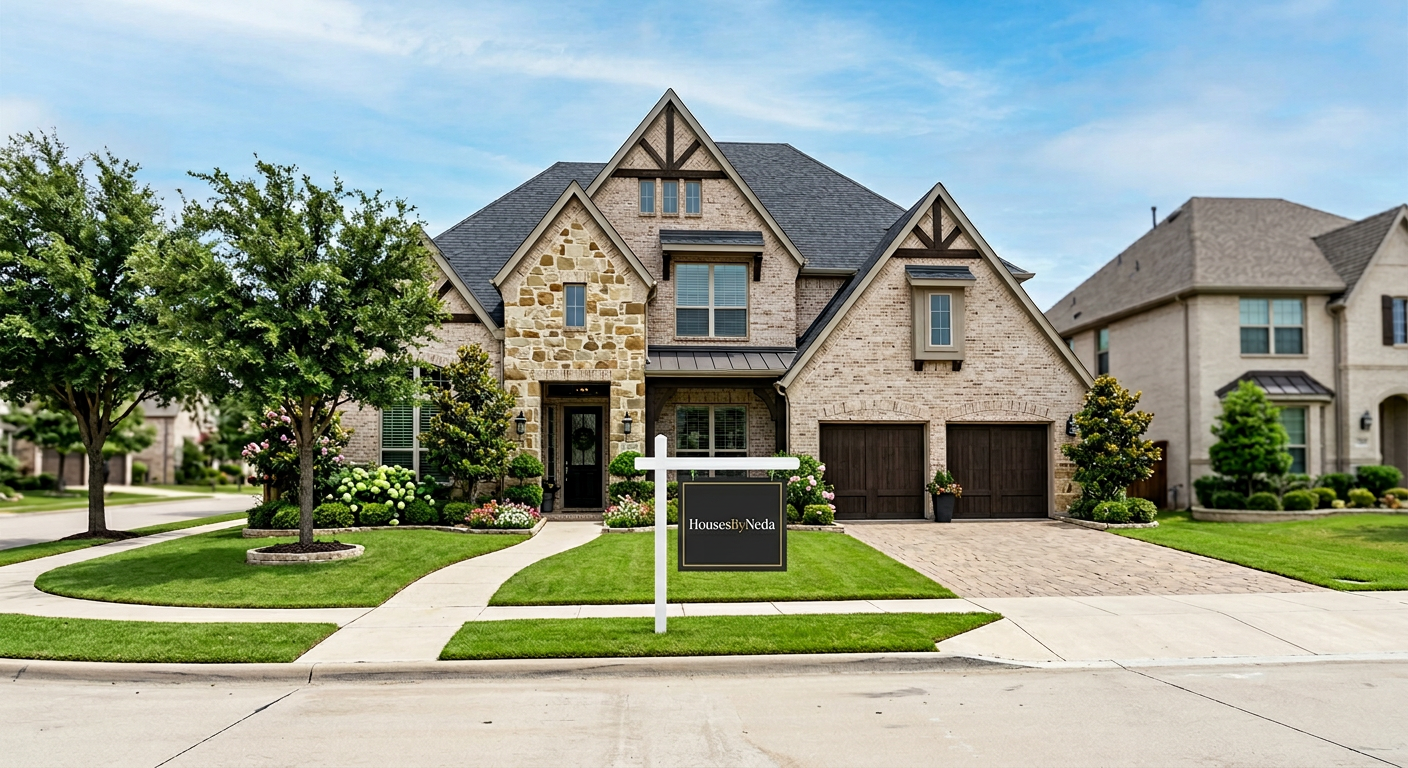
The True Cost of Owning a Home in Frisco: MUD, PID, and What Zillow Doesn’t Show You
By Neda Dameshghi | HousesByNeda | North Dallas Real Estate
The 11pm Zillow Scroll Problem
You’ve done it. We’ve all done it.
Late at night, scrolling Zillow, you see a beautiful Frisco home for $625,000 with an estimated monthly payment of $4,100. Your brain files that number away as “the cost.”
It’s not the cost.
It’s not even close.
What Zillow Actually Shows You
Zillow shows you principal, interest, property tax (often estimated at the wrong rate), and homeowner’s insurance. Standard estimate stuff.
What Zillow Doesn’t Show You
What Zillow leaves out is the entire second layer of costs that comes with buying in North Dallas. These costs can add $400 to $900 per month to that estimate. Before you ever turn on the AC.
Why This Post Exists
Moving to Frisco, Prosper, Celina, McKinney, Plano, or Allen? This is the post I wish every relocation buyer would read before they fall in love with a house.
The financial conversation you have BEFORE you tour homes determines whether you’re a happy homeowner three years from now. Or whether you’re calling your accountant in a panic in April.
I’m Neda with HousesByNeda — your local Realtor and source for everything North Dallas. My background is in accounting and digital marketing. I look at homes the way a CFO looks at investments. Every line item has to justify itself.
Let’s break the real number down.
Why Texas Property Taxes Are Their Own Animal
First, the foundation. Texas has no state income tax. We hear that all the time, and it’s true.
But there’s a trade-off.
How Texas Funds Itself
Without state income tax revenue, Texas relies more heavily on property taxes to fund schools, cities, counties, and special districts. More heavily than almost any other state.
A recent Realtor.com analysis confirmed it. Texas has some of the highest property tax burdens in the United States. We’re also seeing one of the fastest-growing tax burdens between 2023 and 2024.
That’s the macro picture.
The North Dallas Micro Picture
This is where Frisco, Prosper, and Celina buyers get blindsided.
Your total property tax rate in North Dallas isn’t one number. It’s a stack of overlapping rates from multiple taxing entities. The combined rate varies dramatically by neighborhood — sometimes by more than a full percentage point on the same street.
It depends on which special district your lot falls into.
The Typical Tax Stack
Here’s the typical stack for a Frisco home in Collin County:
- City of Frisco
- Collin County
- Collin College
- Frisco ISD (school district)
- MUD or PID (special district — this is the variable)
In areas without a MUD or PID, your total tax rate might be 1.85% to 2.1% of assessed value. With a MUD or PID layered on top? That rate climbs to 2.8% to 3.4% or higher.
What That Means in Real Dollars
On a $625,000 home, that’s the difference between a $1,015/month tax bill and a $1,770/month tax bill.
Same house. Same neighborhood, sometimes. $755 per month difference.
This is the conversation Zillow doesn’t have with you.
What Is a MUD? (And Why It Matters)
MUD stands for Municipal Utility District. It’s a special purpose district. Created to finance water, sewer, drainage, and sometimes road infrastructure for a new development before the city annexes those services.
How a MUD Gets Created
Here’s what that means in plain English. A developer builds a new master-planned community on the edge of Frisco or Prosper.
The city often doesn’t have the budget to extend water, sewer, and drainage infrastructure to that raw land.
So a MUD is created. The MUD issues bonds to pay for the infrastructure. Homeowners in that MUD then pay an additional property tax to repay those bonds over 20 to 30 years.
Typically $0.50 to $1.00 per $100 of assessed value.
The MUD Math
On a $625,000 home in a MUD with a $0.85 rate per $100:
$625,000 × 0.0085 = $5,312.50 per year = ~$443 per month in MUD tax alone.
That’s on top of your regular property tax.
So when a buyer asks me, “Why is this Prosper home’s monthly payment $600 more than the Plano home with the same price?” — this is usually the answer.
What MUD Taxes Actually Fund
MUD taxes fund the bonds that paid for:
- Water and sewer infrastructure
- Drainage systems
- Roads within the development (sometimes)
- Sometimes parks and amenities
When MUD Taxes Go Away
There’s a silver lining. Once the bonds are paid off — typically 20 to 30 years after the MUD is established — the rate drops significantly. Eventually it may disappear entirely.
But buying into a MUD created in 2018? You’re looking at 12 to 25 more years of paying that rate.
How to Find Out If a Home Is in a MUD
Every Texas seller is legally required to provide a MUD disclosure if the home is in one. Your title company will also confirm it during the option period.
The best time to find out is BEFORE you make an offer.
Where Local Knowledge Pays Off
That’s where a local agent who actually knows the neighborhoods earns their fee.
I keep a working list of which Frisco, Prosper, and Celina developments are in MUDs and which aren’t. It’s not a guess. It’s a reference document.
What Is a PID? (And Why It’s Different)
PID stands for Public Improvement District. It serves a similar purpose to a MUD — funding infrastructure in newer developments. But it’s structured differently.
MUD vs. PID at a Glance
The key differences:
| Feature | MUD | PID |
|---|---|---|
| What it is | Special tax district | Special assessment |
| Who creates it | Developer + state approval | City council |
| How you pay | Annual property tax | Annual special assessment (often on tax bill) |
| Tax-deductible? | Yes (as property tax) | Sometimes — varies; talk to your CPA |
| Length | 20–30 years typical | 20–40 years typical |
| Can it be paid off early? | No (bond schedule) | Sometimes — yes, in lump sum |
The PID Math
A PID assessment in North Dallas often ranges from $1,500 to $4,500 per year. The amount depends on the development and the lot size.
Some PIDs are flat per-lot assessments. Others are tied to home value.
The Lump-Sum Option Most Buyers Miss
Here’s the big thing buyers miss. A PID assessment can sometimes be paid off in a lump sum at closing. Either by the seller (if they choose to) or by the buyer.
That changes the math significantly.
Negotiating Around a PID
Considering a home with a $3,200/year PID? The seller may be willing to negotiate a payoff at closing as part of the deal. Or they may not.
This is something an experienced agent will know to ask about.
Where You’ll Find PIDs in North Dallas
Without naming every development (because PID status changes), commonly-PID’d master-planned communities include developments in:
- Parts of Prosper
- Parts of Celina
- Parts of Frisco’s far west and northwest expansions
- Parts of McKinney’s newer northwest developments
Always confirm with current MLS data and the title company. Never assume.
HOA Fees: The Third Layer
After MUD and PID, the third layer is HOA. In master-planned North Dallas communities, HOAs aren’t optional.
They’re the dues that fund the amenity centers, pools, parks, fitness centers, walking trails, and community events that drew you to the neighborhood in the first place.
Typical North Dallas HOA Ranges
- Older Plano neighborhoods (no amenities): $0 – $50/month
- Standard Frisco/McKinney HOAs: $50 – $100/month
- Master-planned community HOAs (Phillips Creek Ranch, Edgestone, Light Farms, Windsong, Trinity Falls): $100 – $250/month
- Luxury master-planned (Stonebriar, Star Trail, Lilyana): $200 – $400+/month
Some HOAs charge annually rather than monthly. Always ask for the actual annual figure and divide.
The Transfer Fee Surprise
Here’s a hidden HOA cost most buyers don’t budget for. The HOA transfer fee at closing.
In North Dallas, this is typically $300 to $1,500. At the time of purchase. The amount depends on the HOA.
Some master-planned communities also charge a capital contribution or resale capital fee of 0.25%–0.5% of the purchase price.
On a $625,000 home, that’s $1,562 to $3,125 — at closing, on top of everything else.
Why You Need to Know in Advance
This shows up on your closing disclosure. But only if your agent has prepared you for it.
Finding out about it three days before closing? That’s a problem.
Insurance: The Cost That’s Quietly Doubling
For years, North Dallas homeowner’s insurance was the cheap line item.
That’s changed.
Why Texas Insurance Costs Have Climbed
Texas insurance rates have risen significantly over the past three years. The drivers:
- Hail and storm claims (North Dallas is in the heart of hail alley)
- Inflation in construction costs (claims cost more to rebuild)
- Reinsurance market pressures
- Insurance carriers pulling out of high-risk markets
What to Actually Budget
A home that cost $1,800/year to insure in 2021 may now cost $3,000 to $4,200/year in 2026.
On a $625,000 home, expect to budget $2,800 to $4,500 per year for homeowner’s insurance. That’s before you add windstorm, flood (if applicable), or umbrella coverage.
Get the Real Quote Early
The number Zillow shows you for insurance is almost always low. Get a real quote BEFORE you write the offer.
Your insurance agent can quote a property in 24 hours from the address alone — no obligation.
This is one of the highest-ROI 5-minute phone calls you’ll make.
The Real Monthly Payment: A Frisco Example
Let’s put it all together. Here’s a side-by-side of Zillow vs. reality on a $625,000 home in Frisco.
Zillow’s Estimate
- Principal & Interest (7%, 20% down, 30-year fixed): ~$3,326/month
- Property tax (Zillow estimate): ~$890/month
- Insurance (Zillow estimate): ~$150/month
- Zillow total: ~$4,366/month
The Real All-In Payment (Home in a MUD + HOA)
- Principal & Interest: $3,326
- Property tax (real rate of 2.95% with MUD): $1,536
- Homeowner’s insurance (real quote): $300
- HOA: $145
- Real total: ~$5,307/month
The Gap
That’s $941 per month more than Zillow estimated. Over a year, that’s $11,292. Over 5 years, that’s $56,460.
This is the gap.
Why This Matters
“I can afford the Zillow payment” and “I can afford this house” are two completely different statements.
That’s why I built a full Buyer Affordability Calculator. With current Collin County tax rates, MUD/PID community data, and homestead exemption toggles. So my buyers see the real number BEFORE they fall in love with a house.
How to Protect Yourself Before You Buy
Here’s the checklist I walk every buyer through.
The 7-Step Pre-Purchase Audit
Step 1: Get the Actual Property Tax Rate
Get the rate for the specific address — not an estimate. Pull the real combined rate from Collin or Denton County’s appraisal district website.
Step 2: Confirm MUD or PID Status
Confirm in writing from the listing agent or title company before option period ends.
Step 3: Get HOA Costs in Full
Get the actual HOA dues, transfer fee, and capital contribution from the HOA management company.
Step 4: Get a Real Insurance Quote
Get the quote before you write the offer — not after.
Step 5: Confirm Your Homestead Exemption Strategy
Talk to your tax advisor. Texas allows up to 20% reduction in assessed value for primary residences. Plus additional exemptions for seniors and disabled veterans.
Step 6: Build a True Monthly Net Cost Spreadsheet
Include all of the above. Plus utilities. Larger Frisco homes can run $300–$500/month for a 3,500 sq ft home in summer.
Step 7: Stress-Test the Payment
Run the numbers at 1% higher mortgage rate and 10% higher property tax. Texas appraisals tend to climb.
The Goal
Do all seven before you write an offer? You will not be surprised at closing.
That’s the goal.
The Bottom Line
Frisco, Prosper, and Celina are some of the best places to live in America. Excellent schools. Exceptional amenities. A real, connected community.
I’m not here to talk anyone out of buying in North Dallas. I’m here to make sure you buy with your eyes open.
The Real Equation
The “true cost” of owning here isn’t a marketing line. It’s an addition problem.
Property tax + MUD + PID + HOA + insurance + utilities + maintenance = the real number.
When you have that number BEFORE you fall in love with a house, you’re in control. When you find it out AFTER, the house is in control of you.
Don’t let Zillow do your math. Let a local agent who actually understands the tax structure of every neighborhood walk you through the real numbers.
Ready to See the Real Numbers for Any North Dallas Neighborhood?
Considering a move to Frisco, Prosper, Celina, McKinney, Plano, or Allen? I’ll walk you through a complete cost breakdown for any neighborhood you’re considering.
MUD/PID rates, HOA dues, and a realistic insurance estimate.
I’m Neda with HousesByNeda — your local Realtor and source for everything North Dallas.
📞 Get the real cost breakdown: housesbyneda.com 🧮 Try my Buyer Affordability Calculator: ask me for the link 📱 Follow: @HousesByNeda
Neda Dameshghi | TX Lic. #794201 | Real Broker LLC
The full picture, not just the pretty one.